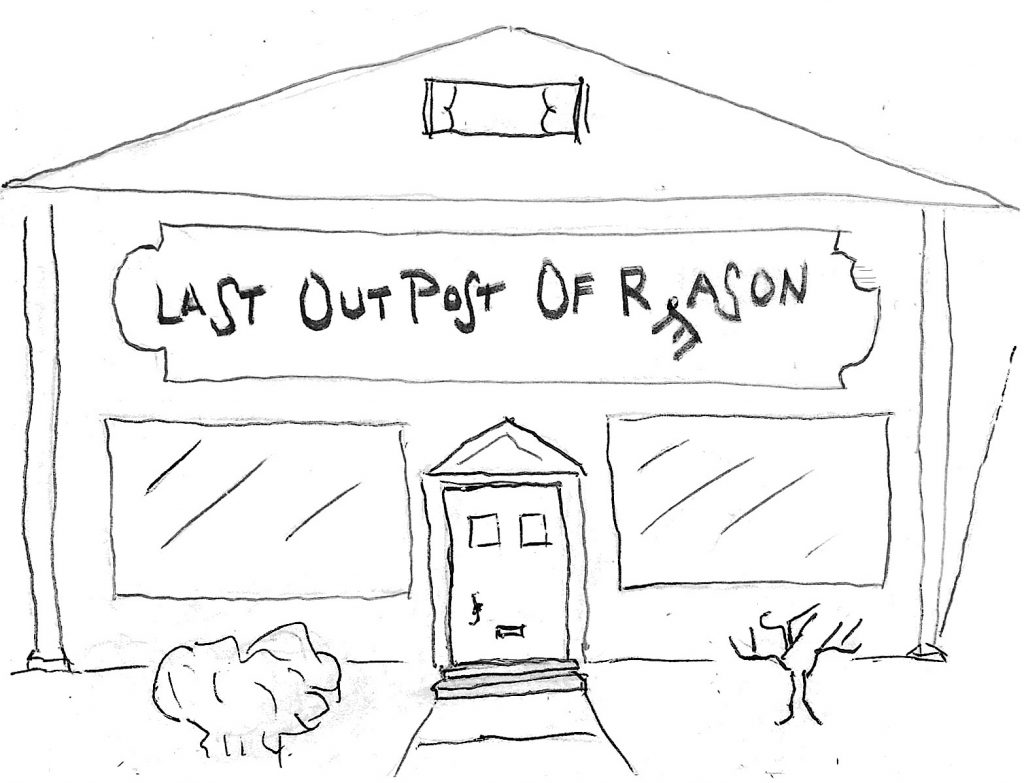
The Last Outpost Of Reason
by Steve Sklar
1.
Ludovic sat regarding the defective hard drive one more time, motionless, as he’d seen the cat who shared this space with him do in similar if not identical circumstances. Ludovic had observed the cat, William, a Persian, grey, inscrutable, watching things, still, attentive. A cricket, a mouse, some little creature rustling and invisible to anyone else. Maybe the thing to do to suss out a problem was to just look at it for a while.
The hard drive was a hefty rectangle of black metal, three times the size of a deck of playing cards. Inside it, he knew, was a mass of chips and silvery pathways soldered onto silicon platforms. It had been the brain of a PC five years earlier. With probes and the appropriate tech specs gleaned from his collection of dog-eared manuals — and renewed patience — Ludovic could probably repair the thing after all. You could fix anything, given enough time.
But why bother?
Why indeed.
What had motivated him to give it another try was the guy who had brought it in.
The shop had not always been called The Last Outpost of Reason. For most of its existence, it had been Bresson’s Sales and Repair, the main computer store in Linden, New Jersey. But come the Decline, when everything went sideways and retail, as such, disappeared, so did Charlie Bresson, bound for where, no one knew. Ludovic, who had been Charlie’s main tech, took over the place, or what remained of it. Eventually he settled on the name that now appeared on a carved and painted wooden plaque above the store.
The man who had brought him the hard drive had done little more than shrug when he’d dropped it off, thereby making it clear that he had little expectation the thing could be repaired. He was paunchy, no longer in his prime, yet something about the faint limp in his walk hinted at an athletic past. More than that, he projected an air of both timidity and confidence, a baffling combination of vibes. Ludovic peered through the smudgy plate glass window of his shop, past the empty parking spots across what was still technically Main Street, watching the man leave in a dusty green Jeep. Ludovic and the cat chose this moment to look at each other, mute, as if sharing one thought: who was that guy?
The repairman returned to his counter and with a probe somehow, uncannily, revived a digital pathway. The monitor screen he’d hooked up to the hard drive flickered for a moment, then displayed the unmistakable signs of a short written work, black letters in Literata font on a white background. At the top of Page One appeared the words:
2.
When he’d dropped off his hard drive, this customer had given his name as Stephen Sklar. What, Ludovic wondered, could he tell about the man based on the story he’d just read on that apparently reviving device?
Not much, other than this: the man was probably a frustrated seeker after fame himself, like the callow youth in his story. Wouldn’t it be true for fiction, as it was said to be true for dreams, that each character you imagine is in some way yourself?
Come to that, might it not be that Ludovic, too, was a frustrated seeker after fame? After all, he had had a moment in his youth, as had the Joseph character in Sklar’s story, when renown had seemed within reach. Then, he had developed code for the programming of computers that was innovative in its simplicity. Or so his teachers had told him. He had even been interviewed on a talk show on account of it. And if a character of one’s imagining or dreams could be a reflection of oneself, why not also a character encountered in fiction that one found it easy to identify with?
The hard drive was now unresponsive to Ludovic’s further probes. Accordingly, he busied himself with other repair items. Not, however, before thinking, with a wry smile — knowing that Sklar was bound to return later that month to check up on his item — “The repairman decided he would wait only two or three more weeks for more insight into this customer.”
As it happened, he only had to wait ten days. Here, now, came this customer, ambling, favoring his good knee, to sit without a word at Ludovic’s counter, typing on the keyboard Ludovic had hooked up to the hard drive and then driving off in his faded green Jeep.
Ludovic looked at the monitor screen. There on it was a second piece of writing. As the Jeep disappeared in a swirl of dust, Ludovic found himself annoyed. What the hell. Does this guy know how to fix his own device, that he can conjure up more data on it seemingly at will? And if so, what the hell am I doing with it?
In spite of himself, he read the newly revealed piece:
3.
Ludovic, sitting with William one sunny afternoon in early spring, realized with a start that he was becoming obsessed with his erstwhile visitor. He was spending more and more time trying to figure out who or what the man was, what made him tick. In the same moment that he became aware of this compulsion, he recognized the likely source of his obsession — solitude. It had been some time since his wife, Holly, had, with Ludovic’s blessing, left him and, also with his blessing, taken the twins with her. And so, what was he to do for companionship but try to figure out his enigmatic customer?
William, his feline companion, was obviously as known to him as he was ever going to get: particular, willful, uncomplaining, inscrutable.
But this Sklar fellow. What could Ludovic tell about him, so far, anyway?
Take his latest revelation, the “If Improv” story. What did that reveal about its author?
That he had a sense of humor, or wanted a reader to think he did, for one thing. And Ludovic was willing to think so. That business of the woodpecker, bringer of insight. Droll.
And what of the sequence, so far, of the writings on Sklar’s hard drive that repair work — or perhaps Sklar himself — had made visible to him?
Might it be that the initial story, “The Solo,” had emerged from digital obscurity first in order to show that the author was imaginative, cerebral, earnest? It might.
And might the next release, the “If Improv” piece, have been the second revelation in order to demonstrate range, to present humor as a counterweight to earnestness?
It might at that.
As if to ask the cat for confirmation of his theories, Ludovic looked at William, who had his eyes closed as he took in the sun through his grey fur. But the Persian merely opened one eye slightly, as if in reproach, then closed it.
The repairman considered engaging his authorial customer in conversation the next time he came in, to get more clues about him than mere speculation could provide. If nothing else, there would be conversation.
However, this would, Ludovic knew, be a challenge. The repairman had been alive on this earth long enough to be able to recognize when someone did not care to talk. Never mind his years dealing with customers, he had lived with Holly. Before she had left with the kids — again, a thing for which he did not fault her — and though on the whole they had gotten along well, there had been moments when with a look or a frown she had made it clear that silence was what was wanted.
Accordingly, when Ludovic contrived to engage Sklar in conversation, he knew he would first have to find out what interested him.
That was how he came to surveil him.
This, too, was, at least initially, challenging. Ludovic did not have a car.
He thought first of following Sklar on the old bike that had been leaning for ages against the back of the building the store was in, sheltered by a sort of half porch there. He could find some oil somewhere, get himself into shape to ride. But how far would he get following a Jeep?
He thought of putting a tracking device under the rear bumper of the Jeep, then remembered that Internet service was now mostly a thing of the past.
Finally, it came to him that he should just inspect the vehicle as much as he could the next time his customer visited the shop.
That is what Ludovic did.
When Sklar showed up at the counter on a rainy Wednesday, taciturn, clearly in no mood to chat, the repairman excused himself, saying he had to look for a delivery, and stepped outside. Sklar could see him through the shop window, but Ludovic did his best to look like the package he was supposedly expecting might have been anywhere out there. Time enough for him to spot two bumper stickers on the back of the Jeep.
One said “Warning: I brake for pedestrians.” The other said “Magnificence Anyhow.”
Bingo.
It was in light of these clues into the author’s life that Ludovic read the next story that popped up on the hard drive after the Jeep pulled away:
4.
Sklar resolved to engage Ludovic in conversation at the next drop-in.
If it’s true that Ludovic, on reading “On The Way Down,” perceived that his customer had some sadness in him, it happened that Sklar thought the same of the repairman. Here was a person with little human contact in his life, his only real companion a cat, for God’s sake.
Finishing the coffee he’d made with the one-cup press that Merry had left behind, Sklar ran through how he might strike up a chat with Ludovic later that very day.
“How goes it?” he might say. No, that was too chummy.
“How’s the repair going?” Better.
Ludovic would be bound to answer that he’d retrieved a few of Sklar’s written pieces from the hard drive – he’d mentioned that already. “It shouldn’t be long now,” he’d probably add.
As Sklar drove to the repair shop in Linden, he chided himself. “Better not to overthink,” he thought, reprising the advice that Merry had often given him.
In any case, as is often the way of such things, the chat did not go as planned.
The cat was on the counter near Ludovic, awake for once. As Sklar entered the shop, the animal looked at him curiously, amber-eyed. Maybe that look was what made Sklar forget his opening gambit.
“Why ‘The Last Outpost of Reason’?” he blurted out.
Ludovic was a bit taken aback. This customer had barely spoken to him before.
The repairman searched for a reply. Surely the question deserved an answer.
“Well,” he said finally, putting down a probe. “I guess it’s because when I took over the shop everthing had gone to shit. People were going crazy – we all were. Drivers’ etiquette, lousy. The business failures. The gangs. The overdoses. The despair. I just wanted something positive on the front of the building. Safe haven. Oasis. Sanity.”
Sklar took this in. “But what about the death of the Internet?” he said. “You repair computers.”
“Yeah, I know,” said Ludovic.
They looked out toward a cell tower near the highway, clearly visible a few blocks away, past rooftops. It stood there in sunlight, functionally useless, beaming nothing, an artifact, a symbol of what once had been.
“Anyway,” said Ludovic, surprised to be talking to this customer. “What can I do for you?”
But before Sklar could answer, as if on cue another piece of his writing arose from the hard drive to appear on the repairman’s monitor.
William, sensing fuss, sauntered down the counter to look at the screen, then began licking a hind leg he’d raised like a flag, signaling indifference. This time both men read the newly revealed piece together, Sklar looking over Ludovic’s shoulder. The title at the head of the piece was: