On The Way Down
by Steve Sklar
These images.
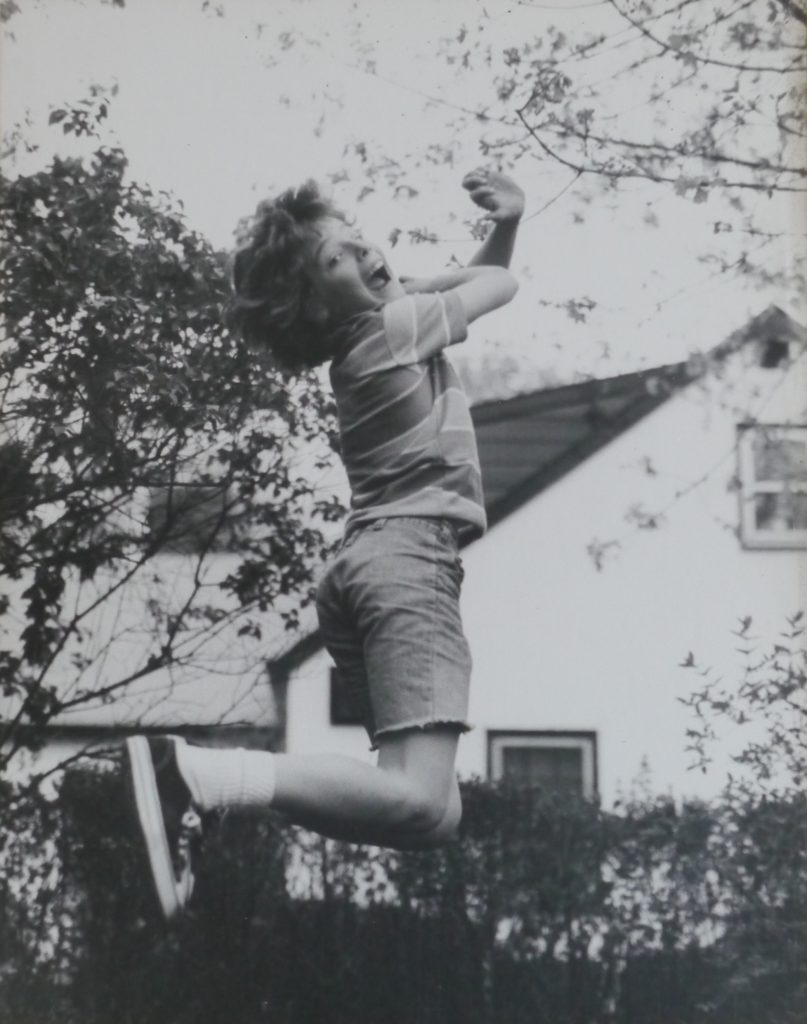
My younger brother Joe — Joey as we called him then — all of ten, frozen in black and white mid-leap above the backyard picnic table in my sister Leeza’s Minolta shot. Suspended exuberant, full of life, aware the camera is capturing him for all time.
Or that early summer afternoon, it had to be around a year earlier, at the Grand Canyon. Joey sits next to me on a ledge near the top; we breathe in the sweet smell of sun-warmed trail dust redolent of donkey shit, gazing out upon the vast space before our perch a mile or so above the canyon floor.
“If I fell,” he tells me, “I’d be going to die anyway so I’d try to do some backflips on the way down.” I am impressed that a nine-year-old can contemplate catastrophe with such poise. Joey seen in the ambers of photo and memory, short, well-knit, good-looking, the sometime darling and youngest of our family, still well within life’s grace.
Later years would be less gracious to him. At eighteen, at the Bread Loaf Writers’ Conference the summer before he is to leave for his first year at Oberlin, he has a psychotic break. This kicks off decades of struggle with bipolar illness, back when it was called manic depression, struggle that only really ends with the end of his shortened and by then beleaguered life.
But still, even during those exhaustingly roller-coaster years, odd moments of grace.
That fraught moment when I have tussled with him to try to convince him to commit himself to Mclean’s psychiatric hospital in Belmont, Mass., the safest place for him then. Somehow in our wrangling he has managed to tear the shirt clean off me and we play tug of war with it; in Cambridge we are panting on the stairs leading up from the T station, having just come back from a random ride out to Quincy. Bare-chested I cling to the sleeve of the contested shirt in this manic Mexican standoff. Two police officers, drawn by our fracas, have arrived at the scene to offer me help. “It’s okay,” I yell at them to back them off, “he’s my brother!” Somehow this calms Joe down, possibly the ludicrousness of it, and in the end he is persuaded to go to Mclean’s.
That moment in our parents’ bedroom a few years later. Joe sits on their bed that late morning, the parents away on some short vacation, and I see fear quite sensibly showing in his eyes as his face contorts this way and that in a twisted mask. He can hardly speak for the muscular distortion. As luck would have it, I’d only recently happened to read about tardive dyskinesia, an undesirable side effect of Risperdal, the anti-psychotic prescription Joe has been taking lately. I am thus able to inform him that the sudden facial torture he is undergoing is, in its way, normal to the situation. Joe reassured, his fear abates; together we weather the muscular storm. Just as well I’d stumbled upon that write-up, otherwise there is no doubt we’d both have freaked out at this bizarre development, the very look you’d cast for craziness if you were staging, say, a Noh play about madness.
In what would be his last year or so of life, Joe would get into crack cocaine. Mental illness is one thing, and it’s not just the ill person but the people who love him who go through it. In that sense, we rode the psychic roller coaster with Joe during his manic or depressive episodes, days he might spend running through traffic or incommunicado in a homeless shelter, and during the periods of respite that separated the episodes, periods when he was able to finish college or hold down modest jobs. My sister acquired a tee shirt in the earlier days of Joe’s tribulations. It read “Madness Takes Its Toll.” They got that right. But crack — that’s a hell on top of a hell.
The lying, the stealing from my mom (my father having by then died in a car accident after leaving her for another woman), the disappearing and the surfacing half a continent away under an assumed name. If what you look for is a modicum of stability, either as a mentally ill person or someone who loves one, then mental illness plus drug addiction is something I cannot wholeheartedly recommend. By the time Joe is hospitalized at Trinitas Hospital in Elizabeth, New Jersey — no more cushy Mclean’s digs for my brother now that insurance coverage for mental illness care has become virtually nonexistent — I am the only one in the family and likely the only one at all who will visit him there. For one thing, in those crack days it is not my patience but my mother’s that has been exhausted by theft. She is the one, not me, from whom Joe has stolen $4,000 by way of credit card fraud to fund some mad jaunt he takes out to Chicago, calling himself Dean Smith there, after the Dean Moriarty character in Kerouac’s “On The Road”.
And wasn’t I myself driven to Nar-Anon in those days? A longstanding therapy skeptic till then, I fled gratefully into that twelve-step program for the friends and relatives of substance abusers. (When Joe heard I had done so, he thanked me for doing him that service. But Nar-Anon gave us license to distance ourselves from our “user.” What we had thought of as nurturing in that direction was now to be seen as enabling, the shift in perspective meant to free us from the grip of a drug habit we had vicariously acquired. Joe was a bit taken aback when, channeling such wisdom, I responded to his thanks by saying “I’m not doing this for you. I’m doing it for me.”)
Risperdal may cause facial contortions; addiction can sunder families.
What then to make of the gift of the Casio? The electric piano still sits in a corner of the sun room in my house, a gift from Joe when, broke as he was, he thereby encouraged me to start playing again.
That gift began its journey to me as a used Fender Rhodes piano, a magnificent beast of an instrument that produced an enchanting and vibraphone-like sound. With scant justification, my brother was an ardent fan of my playing; he acquired the Rhodes on a whim and shortly thereafter gave it to me.
I passed the Rhodes back to him when my wife and I moved into an apartment too small to accommodate it. When Joe started using crack, he sold the Rhodes for cash in order to feed his habit. He used part of the proceeds to buy me the Casio. It was a smaller, lighter and altogether less sacred object than its predecessor had been. But Joe was an addict by then. I marvel that he would have felt compelled to get me the replacement at all.
The hellish period ends when Joe’s body is found in his Ridgefield Park, New Jersey, apartment. On a hot July weekend, following a day or two when none of us have heard from him, my mother and sister have had the super open his door. He’s died in his sleep of congestive heart failure, a casualty of quintuple risk. If madness does not take its toll, obesity, a fatty food diet, chain smoking, lack of exercise and crack addiction probably will.
Naturally, these are not the days I like to remember. I prefer to recall photos of Joe from my wedding, my sister’s wedding, my college graduation, Joe’s college graduation. Or I might call to mind Joe laughing his cackling laugh or making me laugh. (His verdict on the behavior of people we knew, or sometimes of me, delivered with a twinkle in the eye — “That’s crazy, Steve!” — never failed to amuse me.)
The memory I like best, though, is of that afternoon moment, a few years before the advent of crack, when Joe and I lean against a low tile-covered wall outside the old My Favorite Muffin place in Millburn, New Jersey. Joe smokes a cigarette; I’m having one too, just to be companionable. We take our ease in the late-summer light; Joe is in remission and we shoot the breeze, early September and nowhere else we need to be. In this charmed moment, he is my admired and admiring younger brother and we have each other.
Life via manic depression gave Joe a raw deal, no question. But the thing about him is this. During his long plummet to a sad ending he somehow avoided bitterness and remained a loving person, a series of graceful backflips on the way down if ever there was one.
Photo: Leeza Shea