The Solo
by Steve Sklar
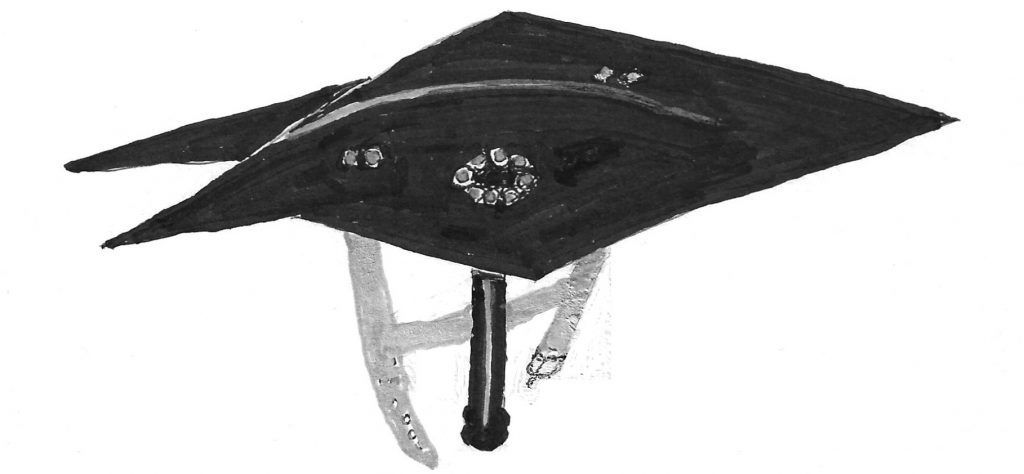
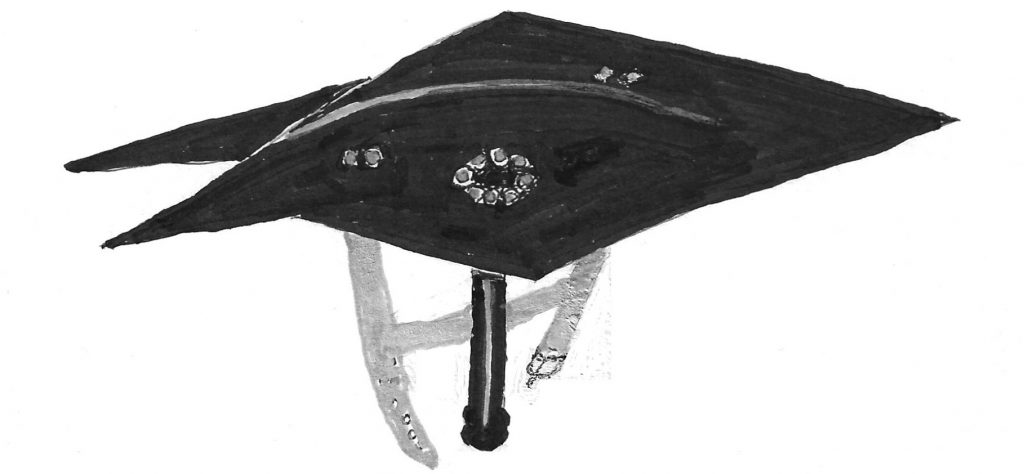
At first, as the fever to fly took hold out at the cliffs, the young man only watched from the comfort of the crowd. The antics of the hopefuls with their contraptions amused him. And, he noticed, even the more cautious among them, those who kept to the flats, could get hurt. Not for him the torn shirt and the mangled knee, the bridge of the nose dragged in the rocky dirt. He was content to enjoy the festive air among the spectators, the men in their top hats and the young ladies in their graceful bonnets.
Then one day he caught the fever himself. To soar! If he did not boast of his new ambition as two or three other fellows in his classes at the local university did, perhaps it was because he’d had only a smattering of science, and that mostly chemistry. He’d laid out his design, it was true, but it was guesswork.
Nevertheless, he would run up and down a grassy field for hours, out of sight of everyone, bearing a rig of black silk above his head. When fatigue overwhelmed him, he’d sit resting under an oak. Then the prospect of taking up his place at his father’s apothecary, never far from his mind, weighed on him. Eventually, a breeze would dry his sweat and cool him off and he’d be at it again.
Although in three weeks his effort took on the acrid quality of a longing destined never to be fulfilled, he continued to spend an hour a day with the contrivance. By the standards of a time yet to come the thing was heavy. There were thick leather straps where a simple cloth harness ought to go, a knobby wooden handle where an aluminum steering-bar might be and wax-coated silk that would have been lighter as nylon.
Early one evening that late September, the young man grew annoyed at a loud creak the handle had developed. He resolved to go home to oil it. One last run and he would call it a day. He picked up the machine, strapped in and loped down the field. His face registered surprise when favorable winds swept him into the sky. More by luck than by insight he had shaped a wing. Months before the world ever heard of the first non-balloon flight at Kitty Hawk he was lifted on an updraft, up, up, to the height of the low mountaintops nearby, then higher still.
The air aloft was thin, cold. In the ecstasy of being airborne, the young man, in his frock coat, hardly noticed it. A plummet of three hundred feet did him no more harm than it would a hunting hawk. He banked in a turn near a cloud and saw the vast horizon slowly tilt and right itself. And the rush of air!
Miles of farmland, forestland, farmland again, swept below him, eight towns in what seemed like minutes. Half an hour passed, more, and still he flew. Behind him he saw the last of daylight making its retreat. Up ahead in the distance, below the setting sun, the great river glinted bronze in the oncoming darkness. Then, once he had crossed above the river, the lights of some farmhouse flickered up at him from tiny windows. The winds were dying. Down into the last gusts of the night sky he dropped.
At three thousand feet, the air still clear, he had a crescent of rising moon and the first glimmering of starlight to see by. He could make out the cloth of his taut canopy against the sky, velvet-black against silver-grey, shadow on greater shadow. His cold hands shone white.
At one thousand feet, at five hundred, at two hundred, he sank through a low-lying cloud. This became ground fog and was joined by a fine drizzle. Ahead through the haze he could see the pillars of a large estate. He landed on the lawn that stretched behind it, running a few steps on wet grass before skidding to a stop. Amber light from lamps somewhere inside the house lit his way across the lawn. At the steps to the back porch, he paused to savor the details of the journey just ended. He pictured the movement of tiny figures, the townspeople he’d been able to make out in twilight during the descent that had started back near the river; he would have been visible to them, too. Even now, these figures must be stumbling over themselves, shouting in amazement that echoed his own. They’d be rushing to find this town, this house.
But more immediate considerations crowded in on him. Where was he? This must be one of the towns at the edge of the state. Which one? He’d never been this far from home. Who lived in the great house? Might he stay here for the night?
In the blackness of the porch he knocked on the door. No one answered. Putting aside his rig, he tried the large oval brass doorknob. The door swung at his touch, letting him into a dark foyer. Light spilled from a dining room up ahead; navigating by this, he moved through empty drawing rooms and parlors. He heard voices, expecting that at any moment a butler or at least a footman would intercept him. He reached the main dining room unopposed. He was surprised at the gathering he found in its light.
Not that they were so odd in themselves. Three boys, a burly young man and a skinny adolescent girl talked loudly as they ate, their mouths smeared with gravy. A pleasant-looking young woman, whose ringlets of reddish-blonde hair fell over her linen smock, sat at one end of the long, polished mahogany table, spooning pablum into the mouth of her wailing baby. A stooped woman in a worn black bonnet helped a suspendered old man in a soiled, collarless shirt to a portion of roast potatoes. These she speared from a sturdy iron pot. The pot was dented and smudged with ashes, as out of place in the middle of the gleaming table as were these people and the din they made in the middle of this grand house.
They received him calmly. Apparently used to feeding the occasional weary traveler, they invited him to join them.
He described his journey. Their reaction left him dissatisfied. The ringleted young woman laughed at him and would not believe his story. What was perhaps worse, the others considered his feat natural and accepted it as a matter of course, their easy, murmured assent due, he saw, to a ready acceptance of miracles. They would believe anything. He took off his coat and fell to eating silently, while the chatter resumed around him.
He would have left the next day, but illness delayed his departure. The time he’d spent in the sky, exposed to mountaintop temperatures, left him shivering that night; when he awoke he was sweating and could hardly stand. Under the matter-of-fact care of the house’s ragged inhabitants, however, his strength returned. In two days, he was up and around.
He prolonged his stay. Days became weeks, then months. In order to be credited for the flight, he would have to be acknowledged by witnesses of the event. He made forays farther and farther afield; these told him that this was sparsely populated country. He decided that the stately house would be the best base from which to encounter his witnesses. In any case, he could scarcely afford to make many land journeys back and forth along the route his flight had taken in search of corroborators, and he was loathe to write his parents to ask them to fund that effort.
His hosts were hospitable with their rambling mansion, and made only the smallest demands on the young man in return for room and board. He worked in the fields nearby, helping them to harvest the potatoes and cabbages they raised. If he thought it odd at first that this family made so few inquiries about his background, if he wondered whether they had done away with the estate’s original owners, he decided soon enough that they were squatters or servants who’d remained behind while the wealthier occupants had moved on, and left it at that.
He spent his days working in the fields and making scouting trips. Despite the drudgery of farming, he was relieved to be away from the grind of schoolwork. And the cheerfulness of the ringleted young woman, undoubtedly a servant-girl in her past, gradually sparked his interest in conversation. Anticipation of fame bestowed on him a certain charm. In their little chats, she seemed to feel its attraction. For his part, he was pleased to be able to recognize when they talked that her hair was the color of sunlight glinting off a river at day’s end.
Again he began devoting some time each day to the cloth glider, running up and down in a cool, soggy area separated by trees from the potato field. He did this partly out of a desire to repeat the wonderful event that had carried him there, partly out of pride: the former servant-girl, whenever their chats came to that subject, still burst out in laughter.
It was just as well that no one in the household bothered to come watch him practice. At this low elevation, without wind, his determined runs never helped him to flights of over thirty feet.
His good mood began to wane. The daily visits out to the road beyond the log fence failed to reveal visitors. He grew restless and short-tempered. In his restlessness, he fell into a dalliance with the ringleted girl, collecting on his earlier charm.
In the first weeks of the affair, it was exciting for him to carry on with her in the attic, over the very heads of her burly husband and her old father, who was shrewder than he looked. But by November, it had become merely interesting — interesting, that is, that they never caught on. He had been thrilled just to hear her name around the house — she was called Becky — and liked that she called him Joseph, not Joe. But her skepticism about his feat began to wear on him. He came to wonder if the trips to the attic were worth the domestic discomfort they were bound one day to cause.
He took to debating with himself whether it might not be time, in spite of the cold, to try carrying his contraption back home. The weight of the thing, which seemed to him somehow to have increased, dissuaded him. There were no horses about the place, let alone a carriage, and the trip on foot would be hard.
By the same token, winter was coming on. For most of the year, the only way to convey a heavy silken rig across the great river would be to cross it by boat. Since the young man had not hired or acquired a boat, he might in theory still prove to the world that he had to have crossed the river by air. But soon the river would be frozen. At that point anyone could cross it on foot, and then only the members of this household, such as they were, would be left to affirm the date of his arrival. More and more, he took to spending his free mornings out at the side steps, in vest and shirtsleeves under a slate-grey sky, gazing into the distance, restive.
Standing like this one day, indifferent to the rare bit of sun that peeked through the cloud cover, he spotted a group of people making their way toward the house. They walked down a muddy slope of ground that wound through twisted pine trees alongside the log fence. The men wore costly beaver hats and long black coats brushed clean even to the tails. There were two women also, wearing many-buttoned overcoats of a fashionable rose color. One white-haired man, with gold-rimmed spectacles, looked to be a lawyer or a judge; the others might have been merchants in one of the nearer towns. They moved past the woodpile, dusted white with the year’s first light snow like confectioner’s sugar atop a nubbly chocolate cake. They picked their way tentatively amid the logs and tree roots, clearly unfamiliar with the whitened ground, helping each other along and looking up at the estate with curiosity. The young man caught the sound of one of the women’s voices on the air.
“This must be it!” she said. “This is just the sort of residence that was described.”
The young man felt his heart beat quickly. In a comical flutter, he wondered whether to go to his silken glider in the backyard or stand humbly for their reception. Becky’s mother rushed out of the house to greet the visitors; the young man stopped his fussing to listen.
“Rebecca,” she called back inside, for once using the girl’s formal name. “Come out here, will you?” From twenty yards off he could hear everything that was said with perfect clarity.
The man in spectacles beamed. “This is Rebecca Dooley,” he announced. “She, ladies and gentlemen, is I believe the one who developed that wonderful apple diet that was so successful with the rubella-laden child.
The young man took this in, immobilized.
“The paper shall have an article about this, doctor,” one of the ladies piped up.
“By all means,” said a bewhiskered man beside the spectacled one. Becky smiled pleasantly at her mother.
As the group began to file into the house, the young man could still make out their words in spite of himself.
“Where is the child? Oh, yes, this is the little Jeremy. Oh, yes, definitely. He is very healthy.”
The young man turned at last in disgust and walked back along the house. He crossed to the back lawn so he could no longer hear the visitors or see them.
He stood looking up at the sky that had greyed over again. “But I’ve been up there,” he thought. Not all the leaves had fallen; the scent of ice was not yet in the air. He decided he would wait only two or three more weeks for the recognition that was sure to come.