In The Shadow Of Disappointment Peak
by Steve Sklar
Late one hazy summer afternoon, in the middle of the bayside inlet at First Encounter Beach on Cape Cod, I thrashed around in snorkel gear, doing my best not to drown. A confluence of circumstances had put me there. Not the least of these was my perennial desire to spot crabs.
Thirty-two years earlier, a young master of ski writing and stoke named Dan McKay had a fatal accident while ski mountaineering alone in the Tetons. Before he wound up unconscious in the early morning shadow of a mountain crag, McKay had been chasing a glory far greater than crab sightings — he’d wanted to be the first to make a complete ski descent of Grand Teton.
Other than the fact that once upon a time we both wrote ski articles for Powder Magazine, what earthly connection is there between my crisis at sea level and McKay’s fall above ten thousand feet?
The story of Icarus holds the answer. Often enough, what puts our lives at risk is not just the unlucky confluence of otherwise innocuous circumstances but our ambition to transcend the routine.
We’ll come back to Icarus. But first, the details of these incidents.
First Encounter
I am one of those oddballs who snorkel the Cape. Like many people, I developed a taste for this activity while on a vacation in the Caribbean. In tropical water, coral reefs and therefore panoplies of brightly colored fish abound. It was there that I discovered that there’s no finer break from office work than watching sea creatures from inside their natural habitat. But on Cape Cod, where my family and I have traveled from suburban New Jersey to spend a week or so nearly every summer for the past twenty-five years, the underwater sightings are more modest. These tend to feature pale white or silvery creatures with, at most, dark green or brown markings — pickerel, herring fingerlings, pumpkinseed fish, and the occasional turtle or crab. Accordingly, the Cape’s freshwater kettle ponds and bay inlets rarely host snorkelers. In these places, when I kick out past wading kids and their parents in a shorty wetsuit that gets tighter year by year, I invariably do so alone.
In the clear water of the ponds, the fish seem to be as interested in watching me as I am in watching them. It’s not unusual for me to turn around in mid-snorkel there to find a pair of pumpkinseeds ogling me, which is fair enough and oddly enjoyable. However at First Encounter — so named because that is where the Pilgrims and Native Americans are said to have first encountered each other — the snorkeling draw for me is the crabs that can be spotted underwater halfway down the clayey bank that stands eighty yards across the channel from the beach.
There are calicos there and darker, rounder and more furtive green crabs. (The green crabs are an invasive species. Like the Pilgrims and, for that matter, my mother and grandparents, they came from Europe.) The crabs scare me at least as much as I scare them. They skitter away sideways when they see me and skittishly I swipe at them with the net I bring on these outings. The sightings are the main point of these forays but I award myself a mental bonus if I can bring a crab back to show to my wife or kids as they read or play on the beach. The captive will be deposited in a bucket of water, to claw its way around within. The creature is dumped back into the inlet when, as happens soon enough, interest in it wanes.
The fear these sightings engender in me is key. Once, two miles from First Encounter, I snorkeled in Salt Pond, no aquatic animals or other people in sight. Trawling for a least one noteworthy visual before calling it a day, I held my breath near the deep center of the pond and kicked down toward the bottom. There I surprised a large calico crab. It stood bolt upright in the sand, deploying its claws angrily. Gasping underwater was counter-indicated, so I settled for shouting into my snorkel. I kicked my way back to shore satisfied, the mutual fright a clear indication of success.
So much for what drew me to the clayey bank at First Encounter on the afternoon of July 17, 2014. But other circumstances made the outing precarious. I’d had a beer at lunch. That induced a post-prandial nap. The nap delayed the moment my wife and I headed out to the beach; the late start put me in the water at the start of ebb tide. As I knew from past outings, that moment when the moon’s gravity, having pulled the tide to its highest point, begins to relent is the worst time to snorkel the inlet. It was Thursday, though, just two days before we were due to return to New Jersey; I did want to make sure to get in my annual trip to the far bank. Moreover, the fuzziness of mind that lingered after the beery nap may be why, once at the beach, I grabbed the wrong snorkel out of our beach bag. Unwittingly I set off with one of the ones our kids used to use beside us in the shallows and not the better one I’d been using for years.
In the middle of the channel the water was eight feet deep; the tide was fast and furious. The sand it churned up made visibility dreadful. Even so, as I kicked across the current through the murk I could just make out the sand ripples at the bottom. They showed that I was making very little headway.
I ought to have turned back then but confidence impelled me onward. I’d made this journey so many times, some of them undoubtedly at high tide. And after all, this time around I did make it to the far bank; I saw a couple of crabs there, too. Sightings accomplished, I figured it was best to kick my way back to the beach promptly and to hell with capture. That was when I discovered the additional circumstance that turned the whole set of circumstances that afternoon into a disastrous mix. My snorkel — my kids’ snorkel, rather, though I didn’t know that’s what it was at the time — was malfunctioning. As I twisted the tube near my right ear to make sure the tip was facing behind me, a plastic set ring, never a part of my own snorkel, came loose. The snorkel started delivering water into my mouth.
With the benefit of hindsight the next day, I realized that there were so many ways I might have managed the situation better than I did. I might have taken off the snorkel and floated on my back to ride the current out to the calmer waters of the bay. Without a functioning snorkel I am not a strong swimmer, but I could at least have done that. I might have returned to the clayey bank, taken off my flippers and climbed up to sit there, to wait out the high tide. I might have kicked my way to shallower waters inland along the clayey bank, using my hands for purchase. Instead, I continued trying to cross the surging channel back toward the beach, thrashing my legs, swallowing gulps of seawater in the process. Panic terror does not welcome a cool head. As my legs churned, I hyperventilated and my heart rate skyrocketed.
Mountain climbers speak of the Death Zone, that region above 8,000 meters where oxygen is so scarce that decision-making becomes sketchy. At sea level that day I had entered a similar zone; I tend to think of it as a set of conditions under which the needle on an imaginary gauge of rationality moves into the red. The Red Zone. Red Zone, Death Zone, what’s the difference? Either way, some flaw in judgment helps put us in peril.
Teepe Col
The mountain climbing ordeal of Dan McKay is another case in point. Though I never met the man, we had a literary bond of sorts. Occasionally, I had written ski articles for Powder. Dan was a regular contributor to that magazine, the real deal. Apparently he was also something of a legend around Jackson Hole, Wyoming. Three decades on, a fellow skier remembered him online not only for having once stood atop a car going at 90 miles an hour to perfect his downhill tuck but for his attitude: “We skied together a fair bit, and I don’t know that I’ve ever known anyone with MORE passion and love for skiing as he had.”
On the morning of July 11, 1982, Dan answered a call to glory. The call was uniquely demanding but probably not much different in kind from the call of stoke he’d answered for years. According to the Grand Teton National Park ranger’s report about the ensuing incident, Dan had wanted “to make the first ‘complete’ ski descent of the Grand Teton” — the first ski descent, that is, with no downclimbing rappel in it. And why not? He was the man who after falling at downhill speed past the bounds of a race course had gotten back up and skied down to finish the course, swinging his skis into a twister off a jump to the delight of the crowd. At Targhee he had entered a gelandesprung competition, a ski-fly fest, and conquered his fear on the in-run to soar nearly 200 feet. Grand Teton Mountain, the highest peak in the Teton range, can be seen from the tops of both Targhee and Jackson Hole, places where Dan often skied and had his being. A first descent on Grand Teton would have seemed within reach.
The ranger’s report says that against his friends’ advice, Dan decided to go it alone rather than wait till climbing companions became available. The report also notes that a deadline for his Powder column loomed. Whatever he was doing that morning, he was going to write about it. After rejecting several routes that were gapped due to snowmelt, Dan, “not an experienced mountaineer although he had climbed the Grand once before,”
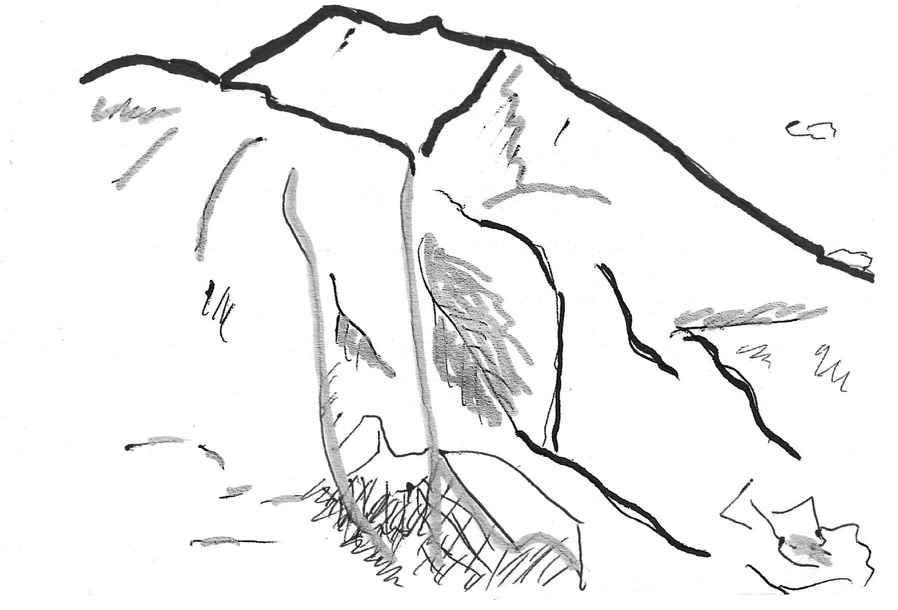
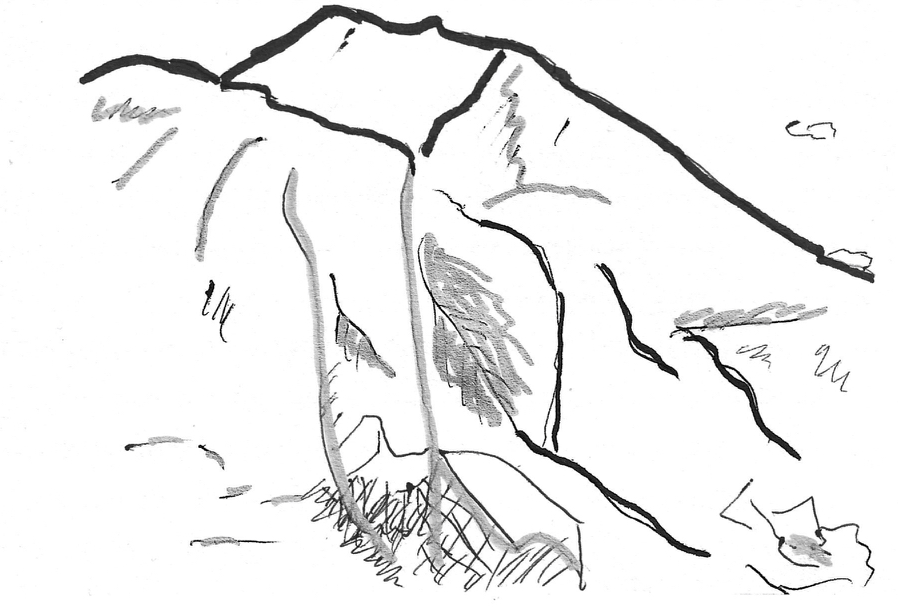
went out toward the lower East Face from Teepe Col looking for a route to ski. Evidence indicates that he traversed from the col on a ledge system and slipped at an exposed corner. He fell about 30 meters to the top of the Teepe Snowfield where his skis and pack were found. After sliding down the snow about 265 meters, he stopped. He had a broken arm and was unconscious. Lying on the snow in the early morning shadow of Disappointment Peak, he died of hypothermia.
Died of hypothermia. Froze to death. The writing in Dan’s Powder articles is funny and lyrical and real. When he died he was all of twenty-six.
Return
In the ebb tide at First Encounter, as I thrashed and swallowed water, it occurred to me that perhaps I ought to yell for help. Nikki, my wife of nearly twenty-five years to that point, sat reading a paperback up on the rise of beach not forty yards from where I thrashed. I could probably cover the distance to her or others with my cries, though I would really have to scream to do so. “HAAAAALLLPP!!!!” I kept mum. Whether that was because I had never been called upon to scream that way before and had not developed the knack, or because my body was loathe to commit time and force to the effort, or in fact because I was too embarrassed to make such an undignified sound, I do not know. But if it was because of the last of those things, my actions that day would stand as proof that I would rather die than yell for help, a prospect I find both remarkable and disconcerting.
In the end, two things saved me. One was my thrashing, which moved me toward a crucial part of the channel. The other was the fact that while I spent critical moments in the Red Zone, the phrase “Go with the flow” came unbidden into my head. From which I understood that instead of fighting it I ought to let the current carry me. Although that mantra did not slow my thrashing or the wild beating of my heart all that much, it did give me the wherewithal to notice that the sand at the bottom of the channel had once again become visible. I realized that the bottom might — who knows, hard to tell — be close enough to the surface there for me to actually stand. In my beleaguered state, taking the risk of standing was itself scary: if it was too deep I’d have lost precious energy in the attempt. But I extended my legs straight down, and found that although the current pushed me and made me stumble around in my flippers, I could just stand. The water level was at the top of my chest. Slowly the hyperventilating abated; the needle went from the red into the black. I tottered my way back to the beach and lowered myself into a chair alongside where Nikki was ensconced in her book. I felt a newfound gratitude just to be sitting on a beach, breathing air.
The glow of that gratitude was not long in fading. Five days later, back in New Jersey, I was doing my best not to get annoyed as I exchanged emails with a pair of clients whose sense of entitlement in a visa application matter made them unpleasant to deal with.
Hubris
The park ranger’s comment at the end of his report on Dan McKay’s accident in the mountains is telling:
Analysis
This is an example of the kinds of things that can lead from a minor mishap to death. An intense desire to achieve a goal, heightened by the pressure of a deadline, can cause one to push too hard. A slip on verglas, or skis sticking out of your pack hitting rock, can cause one to fall. Not wearing a hard hat allows a bump on the head to cause one to black out. Not having a partner prevents one from being helped off the snow and rewarmed.
With minor factual amendments, that forensic analysis might easily have applied to me.
It is indeed the Icarus story that comes to mind. I can’t help thinking that Dan flew too close to the sun, thereby falling into not the cold and deep waters of the ocean but snow-covered oblivion in the inhospitable shadow of Disappointment Peak. As for me, thirty-two years later at lower elevation across the continent, the call of crabs as the moon released the tide very nearly treated me to a similar fate.
Daedalus and Icarus tried to escape prison at Crete by taking flight. The craftsman warned his son not to fly too near the sun or too near the ocean, lest hubris melt his wings or complacency waterlog them. Icarus perished; the story persists.
Some say it is about balance: take the middle path between unbridled ambition and careless indifference. Others feel the story is about exercising restraint in general. Perhaps that is the view of the high-altitude mountaineer Ed Viesturs, who has summited all fourteen peaks above 8,000 meters without supplemental oxygen and lived to tell about it. “Getting to the top is optional,” he says, “getting down is mandatory.”
Sooner or later, one way or another, we leave the mundane behind in pursuit of exaltation. May we have the good fortune to survive the journey.